Monday

Read-Alouds in Preschool

"The reading of literature has a given place in preschools, it is to entertain or offer children knowledge about the world, about language as well as experiences of the relations between humans and other people's living conditions. The doors of unexplored worlds open and processes of envisioning literature may socialize children into trusting their own experiences, the text and their own knowledge. The processes of meaning-making stimulate children's thinking and are constantly affected by the interactions and experiences in the classroom, thus creating conditions for change while fostering the ability to think from multiple perspectives" (Damber, 2014, pg. 1).

"Read-alouds in preschool - A matter of discipline?," by Ulla Damber, carried out a study directed towards the reading of children's literature in preschool with the aim of describing and analyzing how read-alouds were carried out in different preschools in Sweden. The three researchers involved in this research project were teacher educators. Read-alouds were seldom used as an opportunity to expand the children's world knowledge or linguistic knowledge. Linguistic knowledge, world knowledge, and social aspects are linked to one another, according to Damber. As these aspects are linked together, Damber believes that it is possible to visualise how our mapping of read-alouds can depict different foci in activities, a skills focus, a content focus, and a social focus, thus indicating different theoretical perspectives on early literacy.

At the beginning of this research project, Damber asked: How is children's literature used to support language development and knowledge development, as well as identity formation and other social aspects of the learning processes in literacy activities? Against this background, Damber set out to explore "who had agency in read-alouds, how read-alouds were conducted and how language versus content focus was distributed" (pg. 8). The following questions guided Damber's explorations:

  • How often are read-alouds conducted and how long are they?
  • How are books chosen?
  • Who initiates read-alouds?
  • In what learning context do read-alouds take place?
  • What activities precede, accompany and follow on from reading sessions?
  • How are language-stimulating activities linked to read-alouds?
Damber found that reading occurred on a regular basis, but the frequency of reading sessions was often low. On average, read-alouds were conducted six times a week and occurred mainly before or after lunch, during the so-called 'reading rest' time. The most common length of reading sessions was between five and ten minutes. A pattern emerged of allowing the children to choose books for reading. "On 65% of reading occasions, the children chose the book" (pg. 13). The preschool teachers took initiative in 60% of reading sessions, whereas read-alouds were intitiated by the children on 35% of occasions. As mentioned previously, reading sessions most often occurred in connection with meals and 'reading rest' time. In 94% of the total number of reading sessions, the read-aloud was a standalone event, without further connection to other activities taking place within the boundaries of the curriculum. 

In one of the narratives, a student describes how the pictures were hidden so that the children could not get too interested in the content of the story, which brings us to the purpose of read-alouds. The purpose here, seems to have been to create peace and quiet or somewhat of a disciplinary focus. 

In order to enhance children's knowledge, children's literature provides a shared learning context, a meaningful context which provides recurring opportunities to use new vocabulary in different statements and varying situations. Teachers need to embrace meaning-making and emergent literacy afctivities aimed at preparing children to decipher the alphabetic code, as well as real-world engagement (Freebody and Luke, 2003). Teachers need to instill an interest in literature that aims at children's personal development or the enhancement of literacy skills. Teachers also need to take an important step in the creation of a foundation for children's engagement in words as well as in the world.


Damber, Ulla. "Read-alouds in Preschool - A Matter of Discipline." Journal of Early Childhood Literacy (2014): 1-25. Print.

Inclusion

The article, "Inclusion as an instructional approach: Fostering inclusive writing communities in preschool classrooms," written by Erin McClockey, explores how a writing community in an inclusive preschool classroom promoted social engagement and literacy learning of all students. McClockey takes a close look into the life of one student, Ray, to showcase one way in which divergent theories of literacy learning might be bridged.

McClockey begins by explaining how children in the USA who are identified as preschoolers with disabilities can be placed in a range of inclusive preschool settings and there are many differing definitions of what constitutes an inclusive classroom. She mentions how some preschoolers with disabilities are placed in 'true' inclusive classrooms where all special education services are brought into the general education classroom, while at other times preschoolers with disabilities are removed from the general education classroom to receive special education services in other locations. While included in general education classrooms, the preschoolers with disabilities participate in the same activities as children developing 'typically'.

In many preschool settings that are described as inclusive, therapists and special education teachers remove children entitled to receive special education services from their classrooms so that the service provider may address the specific goals in their IEPs. McClockey points out that removal from the classroom, in part, creates a secondary disability that Vygotsky describes as "a disability based on the social implications of an organic impairment (primary disability)" (pg. 51). The message sent to the other students in the classroom, as well as the teachers, is that the child being removed is different and cannot be taught adequately in the classroom. The child is disabled by this removal because he or she is led to believe that instruction must be different for them to learn. During the course of this study, McClockey observed Ray trying to manage these removals. Ray was in an inclusionary preschool classroom, but only up to a point. While Ray leaves the classroom to work privately or with a small group of children who are also classified as preschoolers with disabilities, there are social implications. McClockey asks, "How can inclusion be considered as an instructional approach to avoid this?" (pg. 52).

One way to support the learning and instruction of all children is inclusive writing communities in preschool classrooms. McClockey defines inclusive writing communities as "spaces where all children can sit around the table and create marks, drawings, words, and stories while talking and listening to each other" (pg. 52). In facilitating this inclusive writing community, an instructional goal for the teacher is to recognize each child's strengths as a place from which to support further learning.

McClockey states that if children are taught in classrooms that celebrate the diversity of learning, beginning at the preschool level, it would then be a natural environment as they continue in their schooling. She also notes that an IEP should, at its very core, be detailing how instruction ought to be focused to maximize strengths and facilitate development, and yes using percentages to quantify literacy learning makes its impact as an instructional tool unproductive. A better format might be to describe the instructional environment and a guiding question could be, 'What learning environment would be best to foster the literacy development of all students while providing support for students who are working on social skills?'

Instructional approaches that work from a child's strengths to foster growth provide a context for students to notice each other's strengths. Inclusive environments are classrooms in which 'the attitude is that all students belong everywhere, with everyone else, in the school community' (pg. 62). When preschool teachers utilize an emergent perspective on literacy development, they can notice and support the progress in learning that all students are making. "All students then have an individualized literacy plan, one that honors their strengths and promotes engaged learning" (pg. 63).


Mccloskey, E. "Inclusion as an Instructional Approach: Fostering Inclusive Writing Communities in Preschool Classrooms." Journal of Early Childhood Literacy 12.1 (2012): 46-67. Print.

Mother-child Story Book Interactions

Joan Kaderavek and Lori Pakulski, literacy researchers from University of Toledo, explored literacy interest or orientation of pre-school children with hearing impairment during mother-child story book interactions. These story books included both narrative and manipulative book genres. Analyzing results from the Modification of the Book's Text Rating, Kaderavek and Pakulski found three important aspects of reading and language learning:

  1. children should have more than one opportunity to explore and interact with a book before orientation is assessed
  2. children demonstrated a higher mean level of orientation to manipulative books versus narrative books across the three interactions, and
  3. modification was negatively correlated with children's age (i.e. the text was more likely to be read verbatim with younger children).
Kaderavek and Pakulski stress that story book reading is a critical language learning opportunity. "Story book reading contributes to oral language development and provides a fundamental learning opportunity associated with later reading ability" (pg. 49). Shared parent-child story book interactions are considered to be important contributors to a child's early literacy growth.

The importance of early literacy experiences for children with significant levels of hearing impairment (HI) has been well documented. Children with HI are likely to have language delay and are at risk for reading difficulties. These factors underscore the need for children with HI to experience consistent positive, mutually engaging, and extended story book interactions throughout their pre-school years (pg. 50).

During parent-child story book interactions, children who are hearing impaired have a particular set of challenges that come into play. "Children who are hearing impaired are likely to have a more limited set of world experiences as compared to their hearing age mates (pg. 51). Children who have HI but have hearing parents do not have access to immediate language immersion in contrast to children born to parents who are HI and use sign language. Kaderavek and Pakulski note that this general lack of world experience can limit the underlying language foundation supporting children's comprehension of more sophisticated an decontextualized literate language forms. On the other hand, families who converse in sign language early and fluently may not use story book reading to expose children to the textual features associated with written English. Thus, children with HI are likely to be read to less frequently than their peers.

Two book genres are examined within this study. Narrative story books, where there is a plot or storyline that is communicated by the text and illustrations, and manipulative books that, along with text, contain physical components to engage children (i.e. flaps that can be opened, dials that can be turned). Kaderavek and Pakulski explain that narrative books expose children to story structure or plot, which is a critical early literacy skill that often poses challenges for children who are HI. They also explain that manipulative books, with their increased opportunities for nonverbal participation, may be facilitative for children who are reluctant to participate in book interactions (pg. 52).

Repeated exposure to a book has shown that children developing typically become increasingly familiar and comfortable with the book's concepts, vocabulary, and advanced sentence structure. This results in children reducing labeling behavior and increasing comments on story content. Children also ask fewer questions about the pictures and more questions about the meaning of words and the story.

Through this entire study, Kaderavek and Pakulski found that children showed higher levels of orientation in response to the monipulative versus the narrative book. In general, parents need to maintain and focus on the 'fun and playful' aspects of story book interactions rather than being overly concerned about 'reading the book' at the early stages of literacy exposure. This is particularly relevant for children with HI. Since children with HI are likely to fall behind their typical peers in reading development, it is crucial to maintain high interest and engagement in early exposures to written text in early parent-child book reading interactions.

One aspect of this study that intrigued me was the idea of the 'broccoli effect'. "Just as 'forcing' a child to eat a disliked vegetable increases a child's dislike and avoidance, 'forcing' a child to participate in a story book interaction when the activity is perceived as unpleasant is likely to increase a child's resistance and may inadvertently result in avoidance of future interactions" (pg. 65). The broccoli effect, when applied to literacy, counters the general assumption that reading to chidren 'can never hurt'. Kaderavek and Pakulski argue that the introduction of parent-child literacy experiences in a highly engaging context is one way to minimize the 'broccoli effect'.

The findings of this study have important educational and clinical implications. In order to fully understand the trajectory of children's literacy development, it is necessary to examine children's social-contextual home literacy interactions. While parents and teachers want to expose children to many book genres, manipulative books may be a logical first step or appropriate book type for the reluctant reader.


Kaderavek, J. N., and L. A. Pakulski. "Mother--child Story Book Interactions: Literacy Orientation of Pre-schoolers with Hearing Impairment." Journal of Early Childhood Literacy 7.1 (2007): 49-72. Print.

Sunday

Assessment and Sharing With Families

In a classroom, deciding what kinds of strategies  you will use for assessing students' learning can be difficult. Since time is so valuable within the tight boundaries of things like testing, goals, and numerous students, assessments should not take time away from learning. Assessments can be learning experiences in themselves and finding the strategy that fits best for your student's individual needs is probably going to save you more time in the long run. We need to be using learning assessments that are beneficial for students' learning and that help motivate them to keep learning.

In "Catching Readers Before They Fall," chapter ten focuses on assessments that are inseparable from teaching. Some of their topics include:


  • The importance of authentic, ongoing, and informative assessment
  • How we use informal and formal assessment tools to gather information
  • What ongoing assessment looks like in a classroom
  • How we analyze the information we gather to find out how a child is progressing in constructing a system of strategic actions
  • How we use assessment data to inform our teaching
  • Several methods of documenting and organizing the information collected and how we share this information with all the teachers working with a child


We use the information we collect to tell us which students are struggling and in what areas, as well as which students are ready to move on to greater challenges. Ongoing assessments that actually involve students in the assessment process. This might look like students setting goals with teachers and teachers letting the students feel in control of their successes. These type of assessments encourage students to try their best because they begin to believe in themselves once they see their successes.

Running records are a type of formal assessment tool and are described as "a tool for recording and then interpreting how children work on texts" (Clay 2001, 45). These records have a coding system to record on paper what a child says and does while reading. Looking at running record errors and self-corrections after a child has read will help teachers see if a child was using meaning, structure, and visual information to solve words.

Chapter ten reminds us that "as we continually collect data, we are simultaneously planning our instruction for the whole class, small groups, and one-on-one teaching" (pg. 187).

Every parent wants to know: "How's my child doing?" "Is my child's reading improving?" Chapter eleven in "Catching Readers Before They Fall," explains how many teachers ward off many of these questions by finding ways to communicate with their students' families right from the beginning of the school year to help expand their understandings of how reading works, explain classroom practices that support all readers, and inform them about expectations of what will come home throughout the school year (pg. 200). It is important to carefully draft a welcome letter to the new families. This letter should stress the importance of working together and being partners in their child's education. It is our job to not only teach the children in our classrooms each year but also to help families understand how they can best help their children at home.

Playshop: An Adventure With a Princess

When I found out that I would be creating a film for class, I panicked. I was clueless. I didn't know the first thing about filmmaking, and I had no idea where to start. As I started to calm down, I saw in my syllabus that we would also have to share these films in class. Yikes!

Since the semester was coming to an end, I found myself having less and less time to work on a film with my case study student, *Ryca*. I decided that I would ask my student to tell me what kind of movie he would've wanted to create if we would've had the time. I shared with him that he could create a story, choose/describe characters, and pick a setting, and I would put all of the pieces together and create the movie at home. He shared with me that he wanted an adventure, but not just any adventure. He wanted an adventure with a princess, prince, king, guards, and evil monsters. He wanted there to be a castle for the princess, king, and guards and a cave for the evil monster. He also wanted the prince to come from far away to marry the princess. My smile grew bigger and bigger as I was taking mental notes of his requests. It was really interesting to see how quickly Ryca came up with a story. This reminded me that children have minds full of imagination and creativity, and are just waiting for the right opportunities to share it all with anyone and everyone. As I was waiting for Ryca to fill in the details of the story, he just paused and stared at me. Smiling, he said, "Why don't you make the story?" I gave you the characters and places where they live, so it's your turn now! Make a story!". His final request took my by surprise. It was a really nice reminder that kids think others can be creative as well, and that at times kids like to share with others -whether it's toys, ideas, stories, etc... I was excited to start on this project at home, but first I needed to borrow some toys from my wonderful friend *Nicole*.    :)

In order to create a film, I needed some extra hands. I recruited a friend to help me with the film clips and had him "be" the characters by manipulating the toys. We did take after take after take, and I realized that filmmaking is incredibly difficult. It takes an endless amount of patience to make an entire film come together. We had to create the different voices for the characters, practice each scene before recording, figure out which angles the characters would enter and exit from, and countless other details. It was quite a frustrating experience. Halfway through creating the film, I realized that kids probably don't spend time with details such as these. They probably just have fun bringing these characters to life and just playing with them. I decided to forget about those details and just tried to enjoy playing with toys with my friend. I found just having fun to be a much more fulfilling experience and it turned out to be a hilarious film in the end!

I knew that I would come to class with Ryca's vision of an adventure and my story in pieces, ready to be edited and shared in class. I wasn't sure what to expect for the final version, but I was excited to add some sound effects and music to make the film more interesting.

Although I did not have enough time to create and edit this film with Ryca at school, I think these types of projects are excellent ways to play and tell stories. If I had fun making this film at home, who knows how much fun Ryca would have had making it at school? Projects like these are really engaging for children and give children the open space they need to let their imagination flow.


Click on Me!

Article 5 of my Reading Research Article Collection.

Literacy researcher, Cynthia Smith, explores the ways a young child's play revealed his understanding of technology in contextual and decontextualized ways. In her article, "Click on Me! An Example of How a Toddler Used Technology in Play," she takes a close look at one boy, James, and how he learned how to share CD-ROM storybooks with his mother - who is Cynthia Smith fyi! This article examines the relationship between technology, play, and literacy.

I watched as James and his father enjoyed peanut butter and honey sandwiches at our kitchen table. Between bites, James looked at his father and exclaimed, 'Daddy, click on me!'. Following James's request, his father pointed toward James and said, 'Click!'. James immediately behan singing a nonsense song, as a hypertext item might do when clicked. When he finished his song, he turned to his father and clicked him, by pointing his finger and saying,'Click!'. His father responded by taking a bite of his sandwich and exclaiming, 'Yum, yum!'.

This lunchtime experience is not typical for father and son. In the example above, James and his father are pretending to be hypertext objects that come to life when clicked on the computer screen. 

This article is part of a larger case study involving a comparison of storybook sharing experiences for types of storybooks: traditional, Language Experience Approach (LEA), and CD-ROM. Smith videotaped a variety of activities and looked at the interactions between James and his mother while sharing various storybook media. Smith was interested in analyzing the similarities and connections across these interactions. The data for the study included prompted summaries, parent diary entries, and data sheets. Smith found that the three storybook experiences combined "to create the whole of [James's] storybook knowledge, and his definition of story expanded" (pg. 7). In other words, 'story' became something that James read, created, and did.

In order to understand exactly what Smith was looking at when she explored James's understanding of technology, we need to understand what CD-ROM storybooks are.

CD-ROM storybooks (also called Talking Books) are animated and 'hypertext' versions of traditional storybooks. There are a wide-range of CD-ROM titles, such as Stellaluna (Cannon, 1996), The Polar Express (Van Allsburg, 1996), Sheila Rae, the Brave (Henkes, 1996), Green Eggs and Ham (Seuss, 1996), Just Grandma and Me (Mayer, 1994), and The Adventures of Peter Rabbit and Benjamin Bunny (Potter, 1995-6). The hypertext is a unique component of CD-ROM storybooks. Information in hypertext is designed to encourage individual readers to flexibly explore the relations among intertextual segments. Smith points out "while engaging the hypertext does not change the primary text, the hypertext can elicit various forms of supplementary text...and supports the act of meaning making" (pg. 8). For example, the reader can click on a character within the storybook and the character might sing a song, utter a phrase, or sentence, dance, or serve as a link to a video segment complete with music, oral text, and movement.

Here are some examples of what CD-ROM storybooks look like:


As a result of exploring CD-ROM storybooks, Smith found that James developed a new understanding of the technology, which was revealed through his play. James would often comment on the action of the hypertext and also made predictions about what the hypertext items would do. For James, story became something that you do as well as read. Because of the hypertext component, James's experience with CD-ROM storybooks was multidimensional. "He listened, responded, and repeated text as the narrator read the story, but he also predicted what characters would say when they were clicked and tried to control their actions" (pg. 12). He was able to create meaning through the use of the written text and oral hypertext.

Smith also found that James's experience with complex interactive text led to the decontextualized re-enactments like the play behaviors illustrated during the lunch with his father. "The initial reactions that occurred during the CD-ROM storybook experience became internalized and resulted in dramatic play that occurred outside of the experience" (pg. 13).

James's experience suggests that we as educators must consider how the tools of technology impact the way children think and develop literacy. The majority of today's students have been exposed to technology from a young age and, according to Smith, raises several important questions for this new millennium of learners.

What does technology mean to this new generation of learners?
How has it become internalized?
How will it shape their thinking?
How will it be revealed in their play and how will this play affect their literacy development?


Smith, C. R. "Click on Me! An Example of How a Toddler Used Technology in Play." Journal of Early Childhood Literacy 2.1 (2002): 5-20. Print.

Diva Starz

Article 4 of my Reading Research Article Collection.

At one point or another, we have all found ourselves wandering through the toy sections of a large hypermarket, like Target. What do you notice when you travel through each aisle?  In her article, "'I'm in a bad mood. Let's go shopping': Interactive dolls, consumer culture and a 'glocalized' model of literacy," Victoria Carrington takes a close look at Diva Starz, a line of interactive dolls aimed at young girls for current model of literacy. Carrington argues that "these dolls have much to tell us about the construction of children as consumers, our views about 'childhood', and the models of literacy instruction most appropriate for giving children the skills and knowledge needed to deal with the complex pedagogic texts characteristic of childhood in contemporary consumer culture" (pg. 83).

These dolls are visually unique. There is a symmetry of oversized body parts, with eyes that dominate the face and the entire physicality of the dolls. The exaggerated eyelashes and eyeshadow emphasize this dominance. The eyes with permanently dilated pupils take up a third of the face. They have a small mouth and nose, and no ears. These Divas parallel standard Barbies by height, production, and packaging. However, unlike a standard Barbie, Divas talk to you and to each other.The Divas have their cultural pedigree inscribed on their faces. The facial formation is typical of anime and seems to reflect its increasing influence on contemporary consumer culture. This connection to anime characters connects the Divas directly to entire genres of popular culture -- films, computer games, comic books, and all related merchandising. These dolls are a blending of western and Asian cultural forms.


Carrington explains how the Divas are teaching young girls how to be consumers as well as 'girls'. "Divas demonstrate how to use many of the accessories of the modern childhood presumed by the dolls – mobile phones, stereos, diaries.They also model consumer activities and discourses such as malls and shopping, and each child’s development of desire for and purchase of the doll models the processes of adult consumption" (pg. 89). Many of the key themes identifiable in the recorded dialogue and on the packaging relate to social acceptance, secrecy, ownership and contemporary relevance. They offer demonstrations of how to be older - the kinds of concerns, conversational topics and thematics which characterize older girls; they offer friendship and peer acceptance - not only be providing friendship ('I just know we'll be the best of friends') but also by giving little girls the savvy and street smarts to find peer acceptance ('Let's go to the mall with our friends...'). they even manage to invoke the theme of 'retail therapy' ('I'm in a bad mood. Let's go shopping' and 'I'm so sad. I so need a new school outfit') (pg. 89).

Example of Diva Starz:


When girls assume roles of femininity through playing with these dolls, they are engaging in literacies beyond the scope of traditional models. Carrington argues that "the emergence of consumer culture and the dominance of information technologies in the workplace and as a cultural icon have resulted in a change in the nature of 'text'" (pg. 93). Messages can now be transported across time and place in an increasing number of media and modes. The texts of popular culture often speak directly to 'you'. They do not offer an alternate time, space, or reality. Instead, they are firmly rooted in the here and now. Carrington stresses how these texts are highly relational in ways beyond traditional children's textbooks.These texts rely heavily on a direct connection to the world outside the text, in direct contrast to the texts traditionally associated with childhood. In this sense, the texts of consumer culture are outward looking. Their role is to engage children with the flows of consumer culture rather than insulating them in a distinct, child-appropriate world (pg. 94). As a result, we must now understand 'text' to extend beyond print.

Children require new and different literacies, as they are operating in new and different social landscapes characterized by new texts and technologies. As Carrington points out, toys are one such text - "one such medium for transporting a message across time and place" (pg. 95). Diva Starz then, are pedagogic, training children in appropriate ways of being and making known selected discourses and knowledges. The take-home point from Carrington's article is that "as educators, we must ask ourselves what kinds of literacies are best matched to successful participation in this world of multi-modal and evolving texts.


Carrington, V. "'I'm in a Bad Mood. Let's Go Shopping': Interactive Dolls, Consumer Culture and a 'Glocalized' Model of Literacy." Journal of Early Childhood Literacy 3.1 (2003): 83-98. Print.

Monday

Synergy Between Siblings

Article 3 of my Reading Research Article Collection!

When we talk about the advantages of family involvement for young children, the emphasis is usually upon parents working with children in specific ways and often using school-sanctioned materials. What about family members other than parents? Can siblings also play a crucial but informal role in initiating young children into literacy? Eve Gregory explains in her article, "Sisters and brothers as
language and literacy teachers: Synergy between siblings playing and working together," the nature and role played by siblings informally in mediating each others’ language and literacy learning.


Nine year old Stephanie and her four year old brother Billie are reciting nursery rhymes together:

Stephanie: Humpty Dumpty sat on a wall,
Humpty Dumpty had a great fall 
the King’s . . .

Billie: . . . horses and all the King’s men . . . (falters)

Stephanie: Couldn’t put Humpty together again.


The vignette of Stephanie and her younger brother Billie shown above reveals a smooth synchrony of exchanges as sister and brother conduct a type of ‘duet’ together. Gregory asks, "Might this be typical of siblings’ informal teaching and learning? How far do children emulate their teachers’ or their parents’ teaching strategies; or are their strategies unique? How similar are the literacy and learning activities of siblings from different cultural and linguistic backgrounds living in London?"

Existing studies showing ways in which young children’s cultural knowledge might be acquired in and out of school fall largely into four categories: 
  • those on ‘scaffolding’ between adult and child, 
  • studies into ‘collaborative learning’, 
  • work on imaginative play, 
  • the role of siblings and peers in fostering each other’s learning
Although these categories are widely used by researchers and practitioners, they each come with recent criticisms. The role of the adult is to ‘scaffold’ or support a young child’s learning, gradually removing pieces of the scaffold as the child gains confidence and competence. The idea of 'scaffolding' is criticized for "overemphasizing the role of the adult as expert and, consequently, for implying a passivity rather than activity on the part of the child" (pg. 303). Even the shift to 'guided participation' still implies an unequal relationship between participants in that learning is unidirectional from the older or more experienced person to the younger child. Classroom practice-based research on peers and collaborative learning has been focusing more on the equality of roles between participants in learning. Here, children are revealed as skilled facilitators of classroom learning. Nevertheless, Gergory still argues that interactions have generally taken place in formal situations (i.e. classrooms) where children are engaged in work activities organized by teachers. Imaginative play takes a vital role in learning. In 1978, Vygotsky argued that "cognitive development involves participating in social activity constituted by systems of shared rules that must be grasped and voluntarily accepted" (pg. 304). When children are engaged in fantasy play, both social skills and their rules are learned. "Even more than peers," Gregory notes, "siblings close in age are likely to share a common ‘language’ and cultural ‘recipes’" (pg. 305). However, the view from existing studies on siblings still takes ‘scaffolding’ to be a unidirectional process from older to younger child.

Gergory explains how the nature of siblings teaching each other goes beyond definitions of 'scaffolding' or 'collaborative learning'. "Instead, we refer to the interaction between the children as a synergy, a unique reciprocity whereby siblings act as adjuvants in each other’s learning, i.e. older children ‘teach’ younger siblings and at the same time develop their own learning" (pg. 309). Younger children’s learning is characterized by repetition or imitation of the older child’s actions or discourse (revealed in word-forword reading, games and rhyme plays), echoing (rhymes and songs), listening, requesting help, challenging and general practicing (often school oriented tasks). Older children learn through practicing consciously what they know and through ‘translating’ official ‘meanings’ into personal ‘sense’ and vice versa for the younger child. This is displayed through the direct instruction of their sibling in school-based tasks, demonstrating and providing a model, supplying alternatives, explaining and coaxing the younger child into doing an activity.


The word in language is half someone else’s. It becomes ‘one’s own’ when the speaker populates it with his own intention, his own accent, when he appropriates the word, adapting it to his own semantic and expressive intention. Prior to this moment of appropriation, the word does not exist in a neutral and impersonal language . . . but rather it exists in other people’s mouths, in other people’s concrete contexts, serving other people’s intentions: it is from there that one must take the word and make it one’s own. (Bakhtin 1981: 293–4)


Unlike ‘collaborative learning’ between peers at school (or even outside school) older siblings often share a personal ‘sense’ of words, activities and practices that are important in their everyday lives. Thus older siblings act as cognitive facilitators and younger siblings act as prompters as they play together.These kinds of interactions enables both siblings to practice what they have already learned together.


Gregory, E. "Sisters and Brothers as Language and Literacy Teachers: Synergy between Siblings Playing and Working Together." Journal of Early Childhood Literacy 1.3 (2001): 301-22. Print.


Sunday

'Literacy Nooks'

This week, I will add a second article to my Reading Research Article Collection.

The article, "‘Literacy nooks’: Geosemiotics and domains of literacy in home spaces," written by Sophia Rainbird and Jennifer Rowsell (2014), discusses how home spaces have become networks of information sourcing and learning. Carving out interactive domains in the home, or creating a 'literacy nook,' maximizes learning opportunities and is also one way of asserting parental agency in their children's development. Rainbird and Rowsell suggest that parents construct learning environments, within the home space, for preschool children based on concepts of 'good' parenting. They explored how space is arranged and organized to produce an environment conducive to learning and development. Through four case studies of families in the US, they also found that the concept of good parenting differs from home to home according to socioeconomic, cultural, and class-based ideologies.

Traditional early childhood learning interventions originated from institutions providing literacy education to children in the classroom and encouraging parents to extend literacy learning into the home environment (pg. 215). Rainbirn and Rowsell want parents to be involved in literacy learning interventions by taking an active role in sourcing and securing information and resources into the home space. The idea of 'good parenting' in relation to literacy usually involves interactions around storybook reading in the home, more specifically, shared reading, picture books, and bedtime stories.

Building a learning environment consists of combining different elements - actors, environments, resources, and discourses - from which social meaning can be understood. We can gain a richer meaning about the sort of learning practices that occur in the home space when we consider these different elements together. In this article, Rainbirn and Rowsell considers the home space as the "social meaning construed from the material placement of the signs, discourses and actions within the home" (pg. 216).

Rainbirn and Rowsell analyzed parental spaces to see what 'good parenting' represents based on parents' descriptions of the use of their home space. They identified the following two characteristics:

  1. The nature of objects and artifacts used in the home tied to early childhood literacy (Is there a consumer presence in the home? Is there a deliberate eschewing of consumerism? Do parents have their own space?). 
  2. The nature of childhood space (Is media present? Are books in close proximity and reach of a child? Is there comfortable seating for reading?).

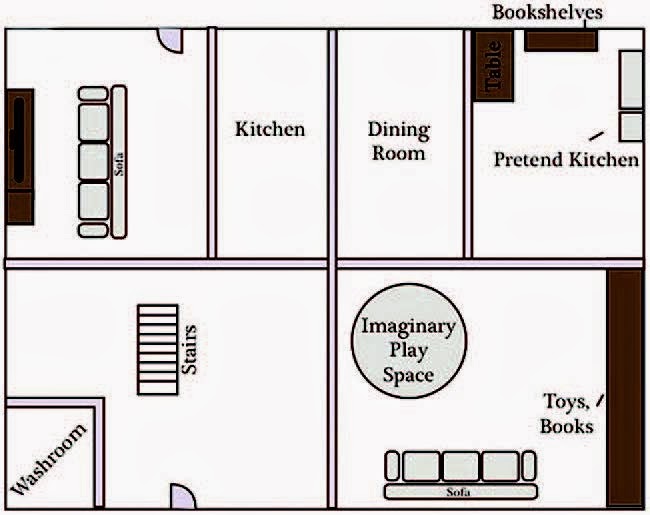
Researchers took field visits to each of the four family's homes to get a sense of place and space. Observations of the use of home space were derived by mapping the space and recording the specific use areas for learning. Parents were also interviewed and asked to show researchers the books, magazines, information leaflets, DVDs, information technology and toys that they had collected, as well as how they were stored or displayed in the home. Rainbirn and Rowsell were particularly interested in the practices that occur in relation to the layout of the literacy spaces. They wanted to consider the relationship between these resources and home space.
By creating visual maps, these researchers were able to show how space reflects philosophies of parental practice. The four homes represented a range from least child-ruled space to most child-ruled space. The fourth home was labeled as the most child-ruled space and was a large home with a very open plan and clear delineated spaces for their daughter. The father of this home is a firm believer in creativity and interpretative play and provides a large space for his daughter to engage in imaginative play. This reflects the idea of role playing as learning, which we have already learned a lot about this semester! The picture below shows the map of this father's house, where most of the right side of the house is space for his daughter.


Rainbird and Rowsell found that there was a distinct difference in the kinds of activities that were deemed important according to gender. "[Mothers] tended to focus on the book and its positioning spatially and within the household routine; the fathers, tended to focus more on personal interaction and literacy learning through less traditional means in the home. Consequently, it could be argued that mothers are more likely to be targeted with traditional methods as to what constitutes good parenting through literacy learning in the home (i.e. book reading), whereas the fathers’ notions of ‘good parenting’ are more open to exploring methods such as family-centred time and imaginative play that involves a different kind of literacy activity space" (pg. 229). 

Paying close attention to the home space can provide us with a richer understanding of the kinds of literacy learning that takes place at home. "As the fluidity of home space creates a blurring of borders between designated learning spaces and family space, the kinds of learning that take place are also fluid as, for example, they blend into family routines" (pg. 230).

As a child, I never had a literacy nook, or a space carved out just for reading or activities, and I can only imagine how much more fun I could have had with literacy. 

There are endless possibilities when it comes to creating a space just for learning! I've collected a couple of pictures from Pinterest just to give you an idea of how this simple space can be transformed into a whole world of its own.


This is a closet remodeled into a reading nook.


 This is an entire play room.


 This is a small window space with books displayed just like at the bookstore!


'Literacy Nooks': Geosemiotics and domains of literacy in home spaces

Monday

Comprehension

In "Catching Readers Before They Fall," chapter eight focuses on the thinking and the teaching behind comprehension strategy instruction. Johnson and Keier suggest that comprehension strategy has a place in elementary classrooms, but question whether or not prolonged strategy instruction is necessary for every student. They recommended the "need for explicit strategy instruction for the struggling readers and advised toning down the amount for top readers" (pg. 135). The group of readers in between struggling readers and extremely proficient readers can also benefit from exposure to comprehension strategies in doses that match their needs. Johnson and Keier state that this body of students could learn to use specific skills (pg. 135):
  • Better infer information from text
  • Distinguish important parts form nonessential information
  • Pick up on subtle humor , sarcasm, or underlying themes
  • Make links from one text to another in order to improve comprehension
  • Expand their knowledge of various topic by activating and adding to their schema
  • Examine an author's perspective or a character's point of view
"Transitional readers are not struggling readers. They simply need a new set of strategies for reading more complex texts... [They are] competent readers who need the support of thoughtful and purposeful instruction" (pg. 136). This is extremely important for teachers to understand about their students. We need to watch our students and look for what seems to be confusing them in their reading. Instead of having a strict lesson plan that is set up way ahead of time, it is important to develop the lessons from where the students are in their reading and writing. This takes a lot of courage. I really admire teachers who have a plan for how they want the day to go and can completely change the lesson on the fly. I know if I had to do that, I would be shaking in my boots because I like routine and sticking to the plan. In my field experience this semester, I have seen the teachers that I work with change their plans calmly and with ease. It's almost as if their plan for the day was to change the lesson plan. It was very reassuring to see a teacher handle a situation like that with no hesitation and carry on the day with cheerfully and joyfully.

The goal for teachers is to get students to move from guided reading practice to using the strategies independently. We need to make it a goal for the students to feel the strategies working for them. Finding meaning and value in their reading process system will allow for them to take ownership of strategies. So, how do we do that? How do we get students to move to independence? Johnson and Keier came up with six reflection questions that could facilitate each participant in finding his or her answer:

1. Was my modeling explicit enough?
  • Was your teaching explicit and focused? The students need to understand that this strategy could help them at another time, while reading another text.
2. What happened during the shared demonstrations? Who talked?
  • Although we may feel that we've had a successful lesson if there were many talkers, we cannot assume that every students achieved the same level of understanding.
3. How much guided practice was given to the students having the most difficulty?
  • Some students will understand immediately following a modeled lesson. However, others may need several lessons on that topic.
4. What assessments do I have in place for checking which students are effectively using the strategies and which are not?
  • "There is no formula for teaching." We need to be observant all through the strategy instructions. Teachers need to take time to reflect on the artifacts that students are creating. 
5. How appropriate were the materials used during the guided practice strategy instruction?
  • While finding a "just-right" level of text is important for the student, teachers need to make sure the text matches the strategy being discussed. 
6. Did I change my language to facilitate transfer?
  • The teacher's language guides and facilitates understanding before it becomes a "reminding" language where he or she prompts students to try specific strategies or behaviors. Then, when students are reading independently, the teacher uses language to reinforce students as they are making connections.

"Learning how to comprehend is not something that is only taught in upper elementary grades" (pg. 153). While this chapter is geared towards the youngest readers, I can't help but see myself being taught how to comprehend. Even as I am taking my master classes, I am experiencing lessons being modeled and learning what language to use with students. I get to see lessons and strategies in writing, hear them told  out loud, see it modeled before my eyes, and also practice with my peers.

Perspective of a Child

Over the next few weeks, I will begin my "Reading Research Article Collection."

Today, I decided to explore some articles in the Journal of Early Childhood Literacy and found an article titled, "When pictures aren't pretty: Deconstructing punitive literacy practices." This article was written by Teresa R. Fisher, Peggy Albers, and Temmy G. Ferederick, all from Georgia State University College of Education.

I thought this article was fitting for my K-3 Literacy course and Art Methods course.This interpretive analysis focuses mainly on how and what young children describe through visual texts, and drawings in particular, especially when written language is not an option. Visual stories are told by children to communicate their thoughts, feelings, and understandings to adults. These stories usually portray cheerful events with family or pets. However, sometimes children's visual texts tell troubled stories of their social and literacy practices, including behavior. This paper specifically dives into a story about a 6-year-old boy, John, who was forced to document challenging moments across his first-grade year through drawings and written text on a mandated behavior form called, 'My Action Plan.'


These researchers wanted to examine the following:
(a) What can a visual analysis of John’s texts help us understand about how he represented and made meaning of his behavior across time?
(b) How do visual and written language operate together to create a narrative of John’s behavior? and
(c) How do both contribute to meaning making in a text/punitive task that he was obligated to compose?


"The literature on the creation of visual texts suggests that this medium is a powerful tool that children use to make visible their beliefs, biases, values, affiliations, positions and identities" (pg. 5). The practice of using writing as punishment has been part of the discourse in the literacy community for a few decades. However, less attention is paid to problematizing the use of multi-modal literacies as a disciplinary engagement for young learners (pg. 5).  Since literacy practices such as drawing are used in a disciplinary way, these pictures need to be critically examined in order to determine: what is being communicated visually, how that communication is significant to the child, and what needs to be done to help the child.

John drew many pictures over time and through these pictures we can see a narrative of John's self-concept throughout the academic year.

At the start of the year, John saw himself as a vital part of the classroom. In general, he used a great deal of color and detail in his pictures, and saw himself in a positive light.

In this picture, he positions himself alone and away from the action of the class. However, John looks at the teacher and the class, and indicates interest in the class action. Even though his teacher (Teresa) has no smile, John visually represents her with energy; she has colorful clothes and red high-heeled shoes. Even though he is in trouble, he draws himself in color, arms raised high to the sky, still connected to his class and classmates, and quite happy.

The following pictures depict John's timeline of behavior in and out of the classroom throughout the rest of the school year.


"Across these images, a once mischievous, bold and happy boy in September, turned violent and angry in the winter, is now resigned, weak and feels little agency in the control he has over himself. His initial pictures were filled with bold and joyous colors which transformed into colorless pictures. His enthusiasm for school waned, as did his writing. Across the latter images, John seemed to care about what he wrote and how he wrote (in complete sentences), and even this aspect of his literacy matters little, though we acknowledge that spending a great deal of time and energy in the writing on such an unpleasant topic likely did not engender a great deal of desire to focus on the quality of writing" (pg. 21).

These visual texts show us that it is not enough to look
at them individually and that we must also examine them over time. It is only when we look at them in the light of other texts (and in this instance, visually) that we can see when significant shifts in their behavior, self-concept or learning represented visually. In John’s case, his pictures trace his changes in his view of himself and his agency (or lack thereof) during troubling classroom-based moments over time. Further, the schoolbased Action Plan itself as an intervention may have been one of several factors which encouraged John to enact the ‘bad boy’ identity instead of serving to aid him in making more positive choices (pg. 22). 

If we are to require children to engage in a literacy practice (or any practice) and do not examine what children do with those practices and what those practices offer and limit, we cannot be certain that these practices are healthy or helpful to our most vulnerable learners. We must carefully consider the impact of these practices. Conversations around these practices are vulnerable, but also empowering as teachers learn to look carefully at visual texts over time and find alternative ways to support children. 


When Pictures Aren’t Pretty: Deconstructing Punitive Literacy Practices 
Teresa R. Fisher, Peggy Albers, and Tammy G. Frederick

Literacy Door

Last semester, I was placed in a fifth grade classroom for my field experience. I felt intimidated by these children before I had even had a chance to meet them. On my first day of student teaching, I remember trembling as I walked towards their classroom door. I assumed most of these fifth graders would tower over me like tall bean stalks and feared that these cool cats wouldn't like me. I thought that the knowledge I carried with me would not be enough to help these kids learn something new. I was afraid that I wouldn't be "smarter than a fifth grader," and I knew that it made me feel insecure about myself as a "teacher".

This semester, I am placed in a first and second grade classroom and will experience what it is like to be a co-teacher. Once again, I feel intimidated and fearful, but in completely different ways than with those fifth graders. These early years, in my opinion, are the most important years in a child's entire educational career, where they learn to read and write. It is frightening to know that I will be an enormous influence in their reading and writing journey. As a learner myself, I am afraid to make mistakes when I become a teacher! However, this time, I also feel more aware of what kinds of students there are in classrooms. I feel more familiar with what kinds of readers and writers there are in classrooms. I feel more prepared to reach out to these different learners because of all the wonderful resources we have been using in our program. More specifically, the readings assigned to us this week have really inspired me to question myself less and to have more confidence in myself as a future teacher.

In a "Voice of Literacy" podcast on early writing, Dr. Deborah Rowe suggests that "all kids [don't] walk in the literacy door the same way." Some students are specifically procedural oriented, some are creative, some are socially oriented, and others are conceptually oriented (students are also combinations of these). Just as teachers have their own interest patterns, so do children. In other words, children seem to have preferences for play. In a school setting, some examples of choices would include solving puzzles, manipulating blocks, and a writing center. Some children are interested in relationships with teachers and other students, and others like to do whatever their friends are doing and want to understand how things work. There are even children who look for creative and new uses for items and objects, and enjoy experimenting with materials and properties. The key point is that teachers need to reflect the variety of interests that children have, instead of just reflecting our own interest patterns. In order to accomplish this, teachers must look at how children approach things and create a classrooms that has a wide variety of literacy activities. "We want to support our children's interests," as Rowe mentions in her interview. We need to understand that "all kids [don't] walk in the literacy door the same way," but they will walk through that literacy door at some point. As teachers, we need to be there to encourage these students as they take this walk!

Once students walk through this mysterious and exciting door, their writing journey begins. While children are busy exploring this new world in their own creative and imaginative ways, teachers need to educate parents on the development of early writing. Just as we oppose the deficit model that blams children for their reading difficulties, we should not view children's writing from a deficit viewpoint. Kate Cusumano explains in her article, "Every Mark on the Page: Educating Family and Community Members about Young Children's Writing," that we should look for meaning when viewing a student's writing. What is the child saying through their words and pictures on the page?

Let's just stop and think about this for a minute.

In my previous post, Diving Into the World of Struggling Readers, I wrote about how children are developing a thinking system, or network of strategies, that helps them make meaning when they read. This same idea of a thinking system can be applied to writing. Children are organizing their ideas and expressing them in a way that makes sense to them. They are communicating. They are making meaning. This is exactly what "successful" early writing looks like.

While searching for meaning in children's writing, we can also look to see "what rules for writing, including accepted writing conventions, the child has discovered thus far," as Cusumano suggests. Children are showing us exactly how they are learning through their writing. "Every mark a child makes on a paper is made for a purpose" (pg. 11). It is important to help parents try to appreciate these marks and try to understand what their young author was thinking when making each mark.

If teachers, parents, and community members can all try to see the value of every part of a child's writing, we will all spend less time worrying about writing and spend more time encouraging and praising children's abilities.

Empower students! Empower parents!

Diving into the World of Struggling Readers

Branching off of my previous post about children first learning how to read, I would like to zoom in and take a deeper look at proficient readers and struggling readers...

In Catching Readers Before They Fall, by Pat Johnson and Kate Keier, one of the biggest concerns mentioned are readers who are continually falling behind despite the plethora of programs, resources, teachers and teaching styles out there. Many questions started to fill my mind.

What is the right path to successful reading?
What does it mean to truly be a successful reader?
What is reading?
Why does reading come so naturally for some and not for others?
As Johnson and Keier mention, Why aren't all kids successful readers?

My first reaction to these questions was to question myself, as I am learning what it means to be a reader and how reading actually works. I wondered if I would feel truly prepared to teach reading to children who struggle when I finish my program and become a teacher. I was, and still am, afraid to fail these children. Struggling readers, and Johnson and Keier explain, "are not doing the kinds of thinking that proficient readers do in their heads as they read...They are not constructing a reading process system in their heads to make meaning from texts and solve problems as their nonstruggling classmates are doing" (pg. 10-1). It is quite terrifying to know that I am responsible for a child's reading difficulties. It is frightening to know that I am responsible for molding these young, eager children into successful readers. My racing thoughts were calmed by Johnson and Pat's insight into what is actually going on in the heads of readers.

So, what exactly is going on in the heads of these readers alongside the teaching they are exposed to? The answer is simply... something else. Children are developing a thinking system, or network of strategies, that helps them make meaning when they read. We each have our own subconscious reading process, and as proficient readers we automatically use our handful of strategies to understand what we are reading. Johnson and Keier suggest that noticing your own system at work is one of the best ways to gain understanding of reading as a processing system (pg. 13). Slowing down and paying attention our thought process as we read will help us understand how we arrived at our understanding of a text. "Reading is thinking guided by print" and proficient readers are actively working to comprehend what the author has written, rather than calling correct words (Lucy Calkins 2005). This efficient reading process system being constructed by proficient readers is not being built by the struggling reader. Therefore, these readers struggle to make meaning from texts as they do not have active strategies to use and are not able to solve problems when stuck.

If reading is thinking guided by print, how can we get those struggling readers to hop on board the strategy train? After noticing your own system at work, you will begin to understand that constructing a reading process system crucial to each individual. Comprehending my own thought process was a very eye-opening experience for me. As a future teacher, I need to be able to talk about the kind of thinking that is going on as a person reads. I need to be able to model it and show students what a proficient reader does. Before panicking about the questions I listed above, I need to take a step back and look at how struggling readers are not constructing their own reading process system, or web of strategies. Instead, as Johnson and Keier recommend, I should be asking myself,

How do I teach a child to construct this reading process system?

"Modeling, thinking aloud, and doing shared demonstrations are a few ways we begin to make our thinking visible for struggling readers" (pg. 18). It is key to remember that the reading and writing process is the same for everyone no matter what level reader/writer you are. In order to help children become successful, proficient readers, teachers must be knowledgeable of how reading works. Also, remember that each child has their own individual way of learning. Be sure to keep in mind that readers need help constructing a system of strategies that makes sense to them. It's all about making meaning of the text!

Literacy Dig and Rollerskating


Sitting in class on Wednesday night, I couldn't help but daydream about the exciting adventure I was going to go on after class. Four classmates and myself chose to complete our community literacy dig at a local rollerskating rink. We thought this would be a fun place where children would often come to play and were curious to see what literacy the children were being exposed to. Of course, in order to truly experience literacy from the perspective of a child, we had to become children ourselves. Therefore, renting skates and taking a few laps around the rink was a must! :)

Our adventure began when we all hopped into Nicole's* van and attempted to drive through the snowstorm headed our way. This mighty-miracle-van was a thing of beauty as it smoothly sailed across the icy blanket of snow and safely brought us all to the skating rink. As we walked through the front door, we were all warmly greeted by a delightful DJ who, I might add, was an elderly gentleman presumably in his 70s. At first glance, there were many signs, arcade games, candy/prize machines, and even an air-hockey table. However, there were only a dozen or so children at the rink. Some of these children were eating in the small cafe area, while others were skating with friends or family members. Looking around at everyone, I noticed it was somewhat of a diverse crowd. There were parents and children with different ethnicities ranging from elementary school to high school. The staff members would help people when necessary and also skate along with everyone else. After we got our skates, we heard the DJ announce Men and Women races. I heard a little girl cheering, "Go Daddy!" for her father to win the race. The DJ seemed to play music for about 15-20 minutes and then announce a game to play before playing music again. He played a variety of genres and used age-appropriate versions of songs. 

The sign for the "Rules" had short phrases with giant, capital letters and seemed easier to read than other signs. There was actually numerous opportunities for children to read things. There were words on all the games, menus in the cafe, restroom signs, t-shirts, and wall signs. While roaming around, I heard conversations about crushes at school, children's bed times, and what to eat at the cafe. It was quite interesting to see children eating and talking to each other, while the parents were quietly typing on their cellphones. There were also parents who were holding their children's hands and skating. One mother and son even had matching roller-skates that lit up blue, green, and red in the dark. It was obvious that skating -something they were all probably good at- and spending quality time with their friends and family meant a lot to these children.

 As a newbie roller-skater, I was quite terrified to lace up my skates and make observations of people and activities on the rink. However, determined to become a pro roller-skater by the end of the night, I stood up and wobbled to the edge of the rink. With legs feeling like jello, I joined hands with my classmates and started floating across the floor. Although it was hard not to stare at my own two feet, it was quite amazing seeing little children zip by me at lightning speeds. I held on to the railing along the wall as if my life depended on it, too fearful to let go for I thought I would fall and make a fool of myself. In that moment, I was reminded of how frustrating and frightening it can be to learn something completely new.

As we get older, we forget how difficult it is to learn something for the first time as most things we routinely do become second-nature to us. Things like riding a bicycle, driving, and even solving basic math problems are so familiar to us all, that it is hard to see how someone would not know how to do those things. We forget how we first learned those new things, and even more, we forget what strategies and motivations we had for learning them. The same idea applies for children who are first learning how to read.

"The Donut House" article, written by Rebecca Powell and Nancy Davidson, provides an interesting perspective on schooled literacy versus situated literacy. When introducing literacy to children in an educational setting, the focus should stray away from "learning to read" and move more towards "reading to learn." Incorporating literacy events that are situated in students' lives, or situated literacy, helps children engage texts and stories in a more critical way. Teaching literacy only using workbooks and exercises, while leaving out the historical and lived contexts of student lives only distances students from literacy events. It is no wonder why many children struggle and resist schooled literacy in various ways. This type of literacy carries no real and valuable meaning for children. It offers no room for creative and imaginative thinking.

One useful model that Powell and Davidson describes in their article focuses on the idea of empowerment. This type of model "engages students in real-life literacy and values students' worlds and their ways of making meaning" (pg. 3). When children perceive an authentic purpose for all of their effort and hard work, they will feel more encouraged to learn and be engaged in learning (pg. 7). An example of this from the article was a teacher who helped his students design and build a new playground in their neighborhood the old run-down playground occupied by drug dealers. In instances like these, the literacy skills and strategies learned are more meaningful to the children because of how passionate they were about solving this real-world problem. In this way, children are able to embrace written language, rather that resist it. Students feel empowered when they recognize their capability to solve problems like these.

Who doesn't like to feel a sense of accomplishment when they have achieved something important to them? 

If there are a couple of pieces of advice to take away from this post today, I hope they would be to:

1.) ADOPT AN EMPOWERMENT MODEL!
2.) Take time today to think about how you felt and what it was like when you had to learn something for the first time. Try to learn to count in Base 5! ;)


*Names have been changed to protect the privacy of my classmates!

Friday

Welcome!

Photo
George R. R. Martin
 
Welcome to my blog!
 
Although I have been living in a world filled with literacy, I have not taken the time to truly appreciate what that means for myself as a learner and a future teacher. My goal is to become a person who has a passion for reading. I hope to encourage my future students to dive into books and live those thousand lives that George R. R. Martin speaks of.
 
Join me as I explore questions, challenges, and strategies surrounding K-3 literacy.
 
Thanks for stopping by!